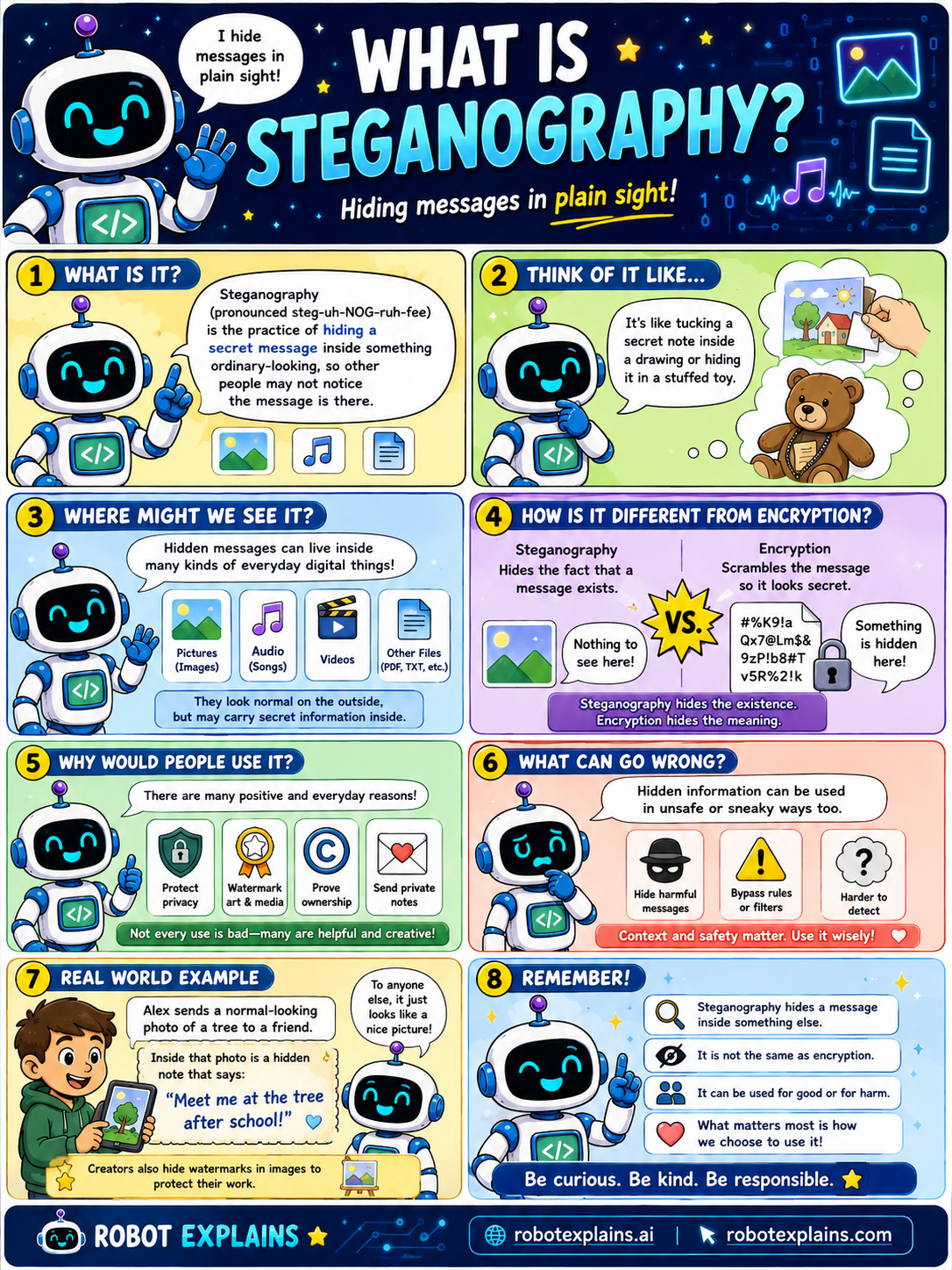
Steganography (pronounced "steg-uh-NOG-ruh-fee") is the practice of hiding a secret message inside something ordinary-looking, so other people don't notice the message is there.
Think of it like tucking a secret note inside a drawing or hiding it in a stuffed toy. From the outside, nothing looks unusual.
Where might we see it? Hidden messages can live inside many kinds of everyday digital things, pictures, audio (songs), videos, and other files. They look normal on the outside, but may carry secret information inside.
How is it different from encryption? Steganography hides the fact that a message even exists, there's nothing to see. Encryption scrambles a message so it looks secret, you can tell something is hidden, you just can't read it. In short: steganography hides the existence; encryption hides the meaning. They can even be used together.
Why would people use it? There are many positive, everyday reasons, like protecting privacy, adding a watermark to art and media, proving who made something, and sending private notes. Not every use is bad, many are helpful and creative.
What can go wrong? Hidden information can also be used in unsafe or sneaky ways, like hiding harmful messages or bypassing rules and filters. That makes it harder to detect, so it's about context and safety, use it wisely.
Here's a real example. Alex sends a normal-looking photo of a tree to a friend. Inside the photo is a hidden note: "Meet me at the tree after school!" People also use steganography to watermark images and protect their work.
Remember: steganography hides a message inside something else, it's not the same as encryption, it can be used for good or for harm, and what matters most is how we choose to use it. Be curious, be kind, be responsible.
What to remember
- Steganography hides a message inside something ordinary.
- It hides that a message even exists.
- It's not the same as encryption.
- It can be used for good or for harm, what matters is the choice.
Words to know
- Steganography
- Hiding a message inside ordinary-looking things.
- Hidden message
- A secret tucked inside a normal file.
- Carrier
- The picture or file that hides the message.
- Encryption
- Scrambling a message (different from hiding it).
For grown-ups
Steganography conceals the existence of a message by embedding it in ordinary media (images, audio, files), unlike encryption, which scrambles a message whose presence is obvious. The two are complementary (hide and scramble). It has legitimate uses (watermarking, privacy) and malicious ones (covert data exfiltration), so detection matters in security.
Want the full story? These go deeper: